

COIL/Aula virtual
The Scientific Liaison Department manages, coordinates, and evaluates virtual scientific collaboration activities, including COIL projects, mirror classes, and master classes.
It is an educational methodology that fosters collaboration between students and faculty, promoting both national and international engagement in higher education, as well as intercultural understanding in a globalized world.
What is COIL?
In a COIL project, students from two or more educational institutions collaborate virtually to carry out learning activities specifically designed to meet shared learning objectives.
Instructors, acting as facilitators, play an essential role in planning and implementing these educational experiences, providing guidance and support throughout the process.
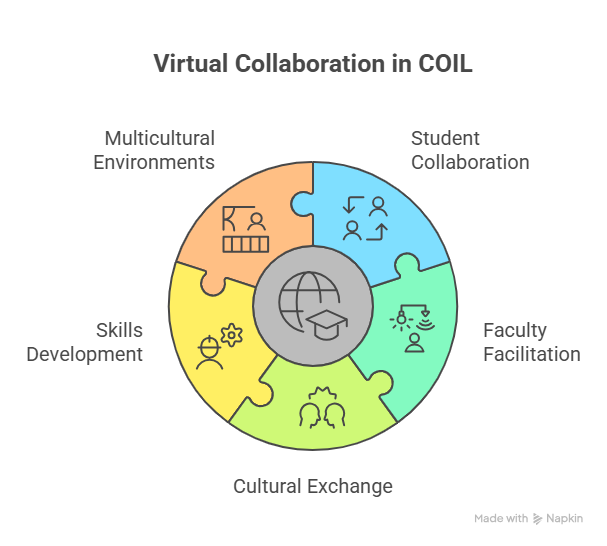
COIL also offers the opportunity to attend classes taught by international professors, take part in discussions and exchange ideas with their students, collaborate on collaborative research projects, and/or create shared content.
The advantages of this exercise include gaining knowledge of new teaching and learning methods, as well as the acquisition of intercultural and global competences by the students, in multicultural and even multilingual learning environments
What is a Mirror Class?
Mirror classes replicate or “mirror” the same learning experience across two classrooms located in different contexts, creating a shared space of teaching and learning between institutions; in which, two or more groups of students from different institutions—often from different countries or regions— collaborate altogether in an academic session coordinated by their respective teachers.
In this format, classes are conducted synchronously or asynchronously through digital platforms. Students work on a common topic, activity, or project, enabling the exchange of academic, cultural, and professional perspectives.
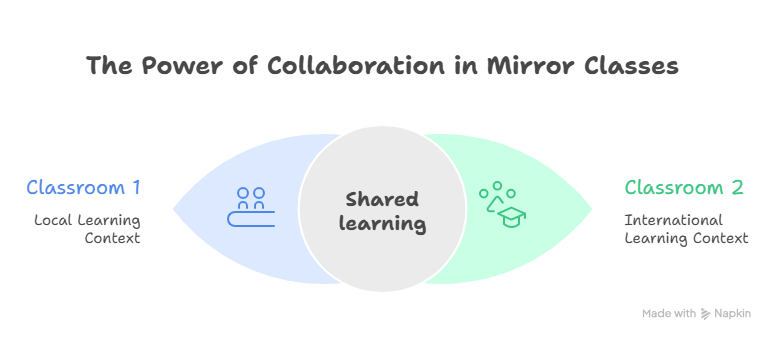
In a mirror class, instructors from both institutions work closely together to design the content, activities, and learning objectives, ensuring the session integrates smoothly into each course’s curriculum. During the session, students may present their work, engage in discussions, solve case studies, compare different contexts, or collaborate on shared tasks. Fostering intercultural learning and the development of global skills.
What is a Masterclass?
A masterclass is an advanced academic session led by an expert, focused on sharing specialized knowledge, professional experience, and critical insights with students or professionals in training.
A masterclass is delivered by an expert or a highly recognized figure in a specific field aimed at students, professionals or interested audience with prior knowledge of the subject.
Its main goal is to explore advanced topics in greater depth, share professional or academic experience, and offer specialized perspectives that are not usually covered in a typical class.
Unlike a standard class, a masterclass usually has a more concentrated and experiential format. It generally includes the presentation of the expert, case analysis, practical demonstrations, discussion of professional experiences, and a space for interaction with participants for questions, comments, or feedback.
They are commonly used to:
- Enrich academic learning through external expertise
- Bring students closer to international experts or leaders in their field
- To delve into frontier knowledge topics or specialized methodologies.
- Strengthen collaboration and internationalization processes, especially when the expert comes from another institution or country.
A masterclass is usually short in duration—ranging from a single session to a few hours or days. It is organized as a special academic activity and may be open to participants from different programs or disciplines.


