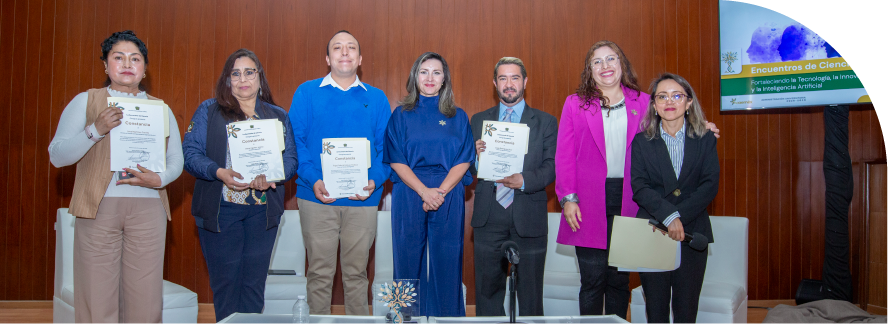
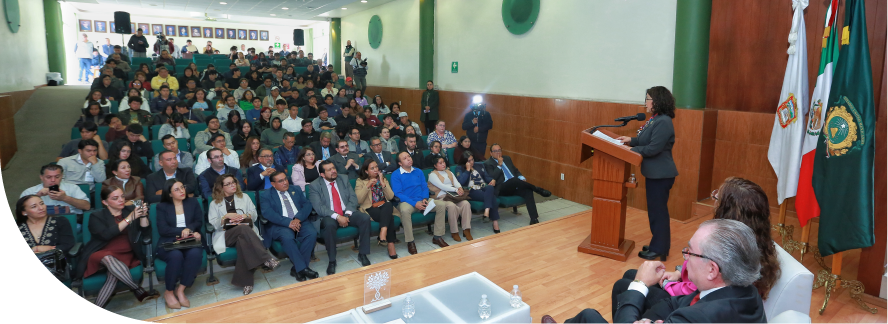
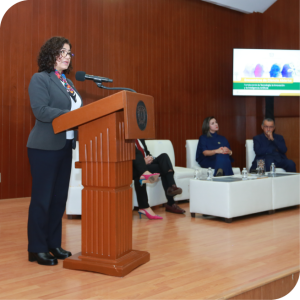
Technology, no matter how powerful, only finds its true value when it is placed at the service of people. Today we paused to reflect on the future we are building through Artificial Intelligence (AI), with a dialogue that marks a milestone for our institution: the beginning of a deep and public discussion about the role that our university must play by facing this change of era.
At the UAEM Tianguistenco University Center, we experienced a day of honest and much-needed dialogue. Guided by the commitment of our Rector, Dr. Martha Patricia Zarza Delgado, to a university that remains engaged with society and responsive to its needs, we came together to recognize that innovation is not a race to move faster, but a pathway toward greater equity.
It was inspiring to share this space with more than 130 members of our community. Seeing young faces and experienced minds gathered in the same auditorium confirmed that the pursuit of ethical technology is a shared concern. At UAEMéx, we are not starting from scratch. Today, 39 researchers are already leading AI-related projects, 11 of them supported through institutional funding and others developed in collaboration with external organizations, aimed at generating solutions for the State of Mexico and contributing to social transformation.
However, technological progress also brings important ethical challenges. One of the most significant is what has been described as epistemic injustice. AI models often inherit the biases embedded in the data on which they are trained. For this reason, we emphasized the urgent need for institutions in the Global South not merely to observe these developments, but to become active architects of the technologies shaping our future. We need an AI that recognizes us, speaks our languages, and reflects our realities.
One of the ideas that resonated most strongly throughout our discussion was the need to view scientific infrastructure as an essential right. Just as access to water and electricity is fundamental to a dignified life, access to data resources and computational capacity should also be considered a public good. It is neither practical nor sustainable for research teams to work in isolation. Open science teaches us that integrating resources is the most effective way to reduce costs and foster meaningful innovation.
Joined by Luis Fernando Bravo Navarro, Director of the Digital Agency of the State of Mexico, we reaffirmed that digital transformation can only succeed if it is inclusive. Through initiatives such as CienciaCercana and our open-book repositories, UAEMéx is already demonstrating that knowledge should circulate freely and without barriers.
Social transformation is not measured by algorithms alone, but by people´s ability to understand them, make use of them, and improve their realities through them. Let us continue advancing a transformative model in which open science becomes a driving force for a more just, ethical, and human-centered future for all.
#tuaeméx
#CienciaAbiertaQueTransforma
Autonomous University of the State of Mexico
Instituto Literario #100, Centro, 50000
Toluca de Lerdo, México